
Understanding Dukes County Releases
A Dukes County release is the end or change of one agency's legal custody. It does not always mean the person went home. The Dukes County Jail and House of Correction serves as the island's regional police lock-up, its pretrial jail, and its house of correction for county-sentenced men. Someone may leave after bail, personal recognizance, a court order, time served, sentence expiration, or parole. Another person may be recorded as released because the sheriff delivered him to the Massachusetts Department of Correction, another county, federal authorities, or another lawful custodian.
That difference controls the search. The sheriff's booking and release file documents what happened at the Edgartown facility. A court docket explains the order, disposition, sentence, and any probation term. A state, federal, or immigration locator matters only after the county record points to that system. A missing name alone proves nothing, especially because the Dukes County Sheriff's Office publishes no online current-inmate roster or release archive.
Dukes County Release Types
Massachusetts uses specific release terms. They should be read as custody events, not as a verdict on the case. The same term can also lead to a different next step. For example, parole permits part of a sentence to be served in the community under Parole Board control, while release to another criminal-justice agency keeps the person in custody elsewhere.
The official Massachusetts release-type descriptions show the vocabulary used across correctional records.
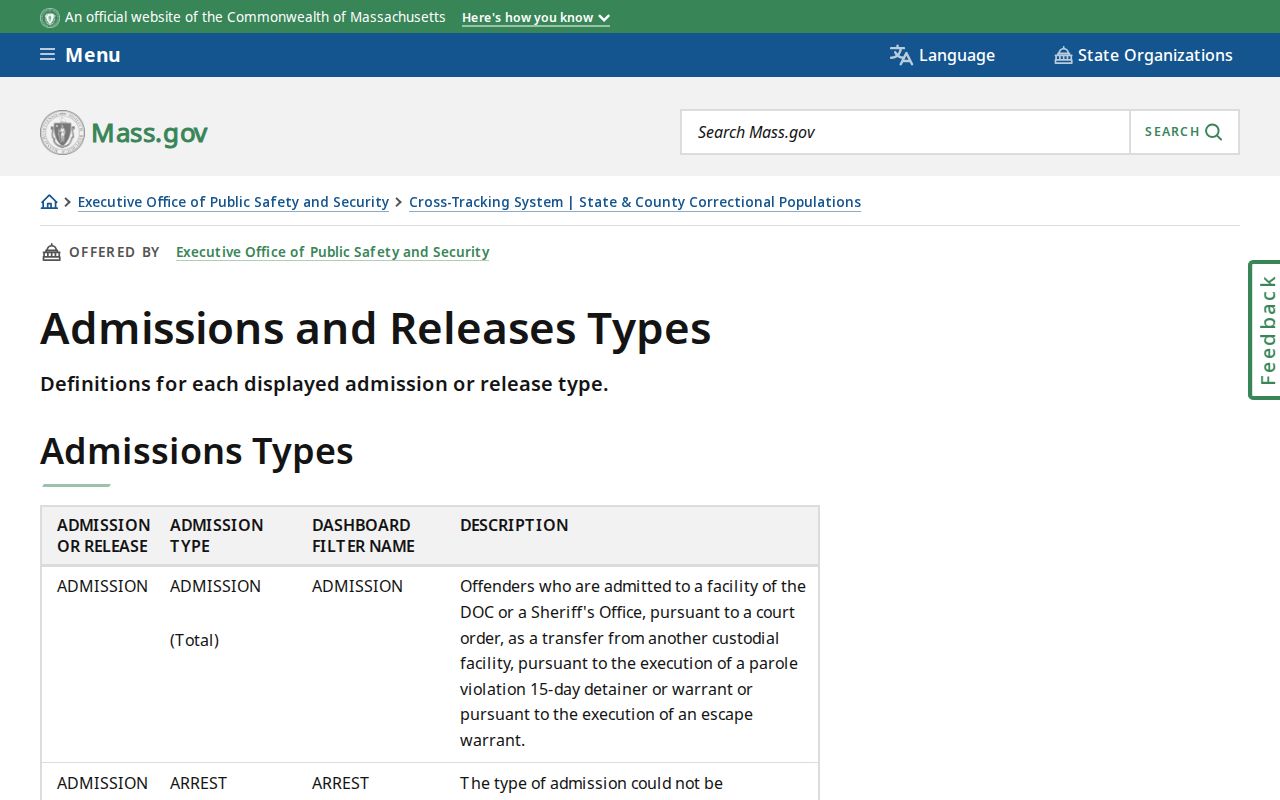
Those terms help a requester ask for the right Dukes County release category and distinguish an actual community exit from a transfer.
| Release type | What it means | Best next record |
|---|---|---|
| Bail or personal recognizance | The person leaves custody while the case continues, after meeting bail or promising to appear. | Sheriff release entry plus the court docket and conditions. |
| Court release | A court-directed event ends that custody status. | Release timestamp plus the signed order or docket entry. |
| Time served or expiration | Confinement already satisfied the term, or the adjusted term reached its end. | Release sheet, sentence calculation, and docket. |
| Parole | Conditional community release while the sentence remains under Parole Board jurisdiction. | Release record and Parole Board material. |
| Transfer | Dukes custody ends and another agency takes custody. | Dukes transfer record followed by the receiving agency. |
| Death | An administrative release category, not a community release. | The custodian's official record, subject to access limits. |
Note: Probation is a court-supervised disposition and may follow release, but it is not itself a sheriff release category.
Dukes County Release Record Fields
The Dukes sheriff has not posted a blank release form or public data dictionary. Still, official Massachusetts records describe the institutional facts that can be requested. Ask for the existing booking and release records, not a newly created report. A precise request can seek the actual release date and time, the legal category, the authority for release, and any receiving agency. It can also connect the custody event to a court docket and a post-release supervision note if one exists.
A release timestamp and a court disposition answer different questions. The jail record shows when that custodian processed the event. The docket shows what the judge ordered and how the case moved. Neither record should be used as a substitute for the other.
| Field to request | What it can show |
|---|---|
| Name and institutional identifier | Links the record to the correct person and booking. |
| Admission date and legal status | Shows when custody began and whether it was pretrial or sentenced. |
| Releasing facility and agency | Identifies who carried out the release or transfer. |
| Actual release date and time | Records when that agency's custody status ended. |
| Release category and authority | Separates bail, recognizance, court release, time served, expiration, parole, or transfer. |
| Destination or receiving agency | Shows whether the person returned to the community or remained in another custody system. |
| Court and docket number | Connects the jail event to orders, disposition, sentence, or probation. |
| Property and account closeout | Documents institutional discharge steps, though it is not usually a public locator field. |
Request Dukes County Release Records
The Dukes County Sheriff's public-records page names Special Sheriff Kayla Pachico as Records Access Officer. A request may be made by email at records@dcsoma.org, by telephone at 508-627-5173, by fax at 508-627-8496, by mail to P.O. Box 252, Edgartown, MA 02539, or in person at 149 Main Street. Writing is not required, but the sheriff recommends it for accuracy and completeness.
The official request page shows the direct route for a county release record and booking document.
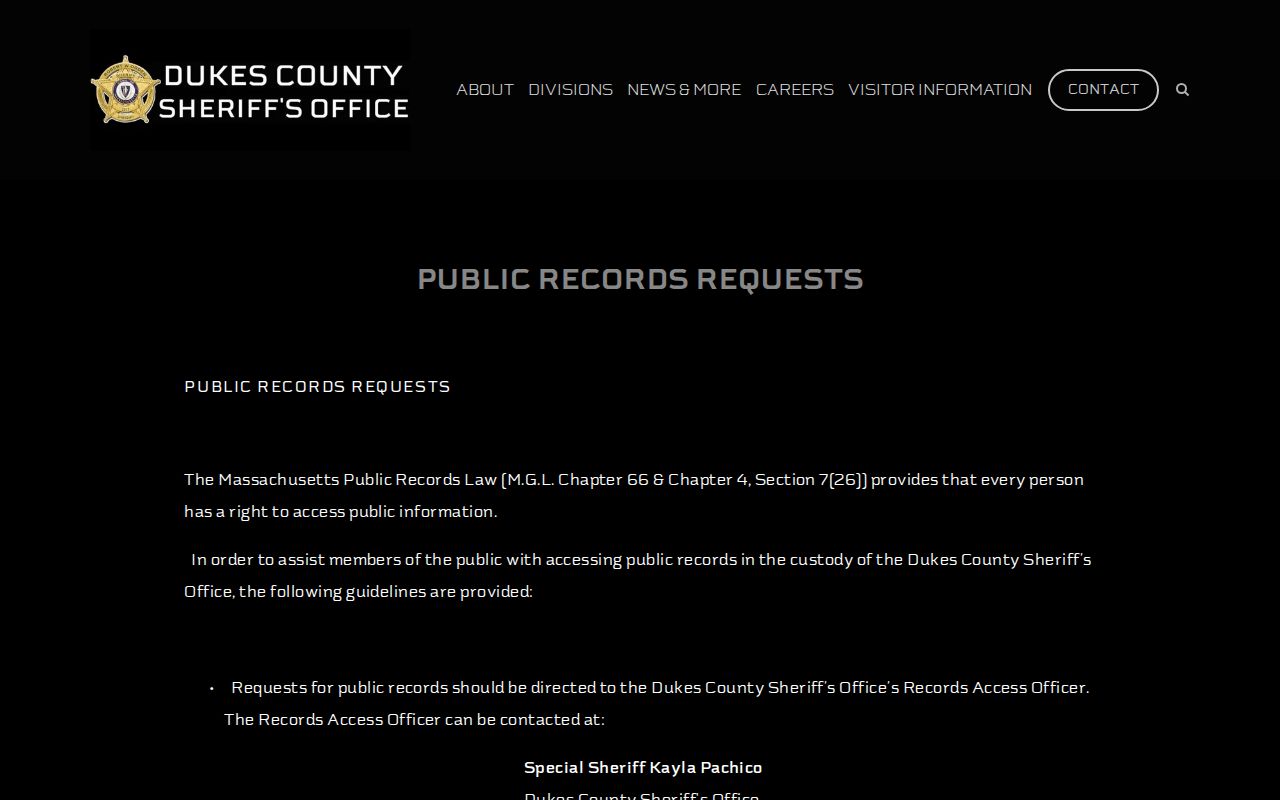
A narrow written scope helps the Records Access Officer locate the right booking event and explain any fee, redaction, or exemption.
- Give the person's full name and known name variants. Add a date of birth only if it is lawfully known.
- State the approximate booking and release dates. Include the booking or inmate number when available.
- Name the existing records sought, such as the booking sheet, release sheet, release log entry, legal authority, destination, property receipt, or booking photograph.
- Ask for electronic delivery. Request a fee estimate before the office incurs charges above a limit you choose.
- If material is withheld or redacted, ask the office to identify the legal exemption used.
149 Main Street
Edgartown, MA 02539
508-627-5173
Monday-Friday, 9:00 a.m.-5:00 p.m.
Dukes Release Records and Law
Massachusetts Public Records Law governs requests to the sheriff. Under M.G.L. c. 66, §10, a Records Access Officer generally responds as soon as practicable and within ten business days. A response may provide records, give a reasonable production time and fee, seek clarification, or cite a legal basis for withholding. It does not always mean that the full record will arrive within ten days. The sheriff posts no fixed Dukes release-record fee, so ask for an estimate.
The definition in M.G.L. c. 4, §7(26) includes exemptions. Juvenile information, medical facts, victim data, security details, some investigatory material, CORI restrictions, and court orders may limit what is released. The statewide retention schedule sets minimum periods for specific series, including 25 years after release for house-of-correction files, three years after final release for listed detainee files, and one year after release for personal-property records. These periods do not guarantee public access or online display.
Massachusetts has separate official routes to seek sealing and seek expungement in qualifying cases. Sealing restricts ordinary public access. Expungement is a narrower statutory remedy. Neither happens merely because a person was released, and neither should be treated as a promise that every independently held record vanishes.
Property After a Dukes Release
Release processing can leave a separate trail beyond the release order. Massachusetts schedules a sheriff personal-property record for one year after release. That record may help resolve what the institution logged when property was returned, but it is not a custody locator. A question about the Edgartown jail's release paperwork or property record belongs with the Dukes sheriff.
The route changes for a Dukes-connected woman held at Barnstable County Correctional Facility. Barnstable lists separate Inmate Property and Inmate Accounts contacts, and its published guidance says a remaining account balance may be issued on a debit card after custody. Those are Barnstable practices, not Dukes policies. Contact the physical custodian that processed the release. If a release entry is wrong, ask that sheriff about the correction. If the error is in a court docket, use the Trial Court's record-correction route.
Find Dukes County Released Inmates
A released-first search starts with custody, then follows the legal trail. This matters in Dukes County because there is no sheriff roster to search and because women in Dukes cases may be held off-island at Barnstable. It also prevents a state-prison or federal tool from being used for a county-only booking.
The Dukes sheriff publishes no official 24-hour or 72-hour release feed, no update schedule, and no online field list. For a recent period, ask the Records Access Officer for an existing release log or individual release records covering exact local dates and times. Request the name, booking identifier, release date and time, category, and destination to the extent those fields exist and are public. MassCourts may show the judge's order, but it is not a complete county release list and does not replace the sheriff's processing record.
- Identify the last known custodian. Start with Dukes for a male county booking, Barnstable for a documented regional placement, MADOC for state prison, and BOP for a federal prison term.
- For one known person, call the facility about current status. For durable proof of a past event, request the existing release record.
- Check MassCourts with the docket number when possible. Review release orders, bail, recognizance, disposition, sentence, jail credit, probation, warrants, and later changes.
- Use the Massachusetts DOC and VINELink route only for a person in state DOC custody. Request MADOC records when a former state prisoner no longer appears.
- Verify parole through the Parole Board and probation through the sentencing court, subject to public-access limits.
- When a county record names another agency, follow that agency. Use BOP for federal prison records and ICE's locator only for its documented immigration-custody purpose.
- Compare at least two records when possible: the releasing agency's date, type, and destination, plus the court or supervising agency's continuing status.
MADOC Search After Dukes Release
The Massachusetts Department of Correction locator instructions route current state-prison searches to VINELink or 866-277-7477. Search inputs are a full first and last name or a commitment number. Massachusetts also says only MADOC participates in the state VINE program. That means VINELink cannot be represented as a Dukes County jail release archive.
The state instruction page makes the current-custody scope and VINE limit clear.
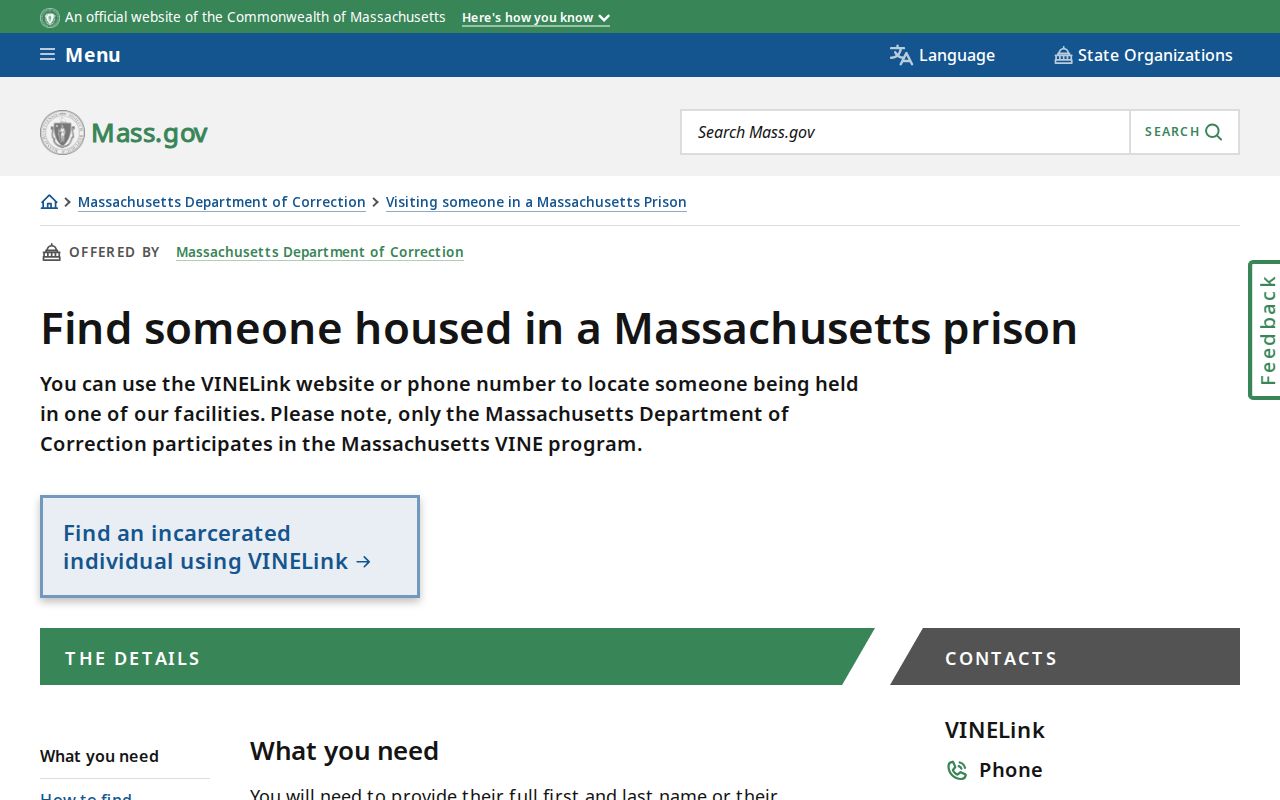
Match identifiers before relying on a result. The public route does not promise a durable released-offender record, a release-retention window, or a projected-date field. If a former MADOC prisoner is absent, request the certificate of release or discharge and final sentence computation from MADOC, then check the sentencing docket and Parole Board record if relevant. MADOC expressly redirects county jail and house-of-correction requests to the county custodian.
- Discharge
- The end of the governing custody or sentence status, documented by the responsible agency.
- Mittimus
- The court's written commitment directing custody and carrying sentence terms.
- Parole
- Conditional release while the Parole Board still controls the rest of the sentence.
- Probation
- Court-ordered community supervision, which may follow custody or stand as a disposition.
- Detainer
- A request or notice that another authority may take custody when the first custody ends.
Note: A calculated sentence date can change; the final agency record is the source for the actual release event.
Courts Behind Dukes Release Records
Edgartown District Court, Dukes County Superior Court, and Probate and Family Court share 81 Main Street, but they have different clerks and legal roles. Edgartown District Court handles arraignments and many criminal cases from the island towns. Dukes County Superior Court handles serious felony matters. Probate and Family Court is not the usual office for an adult criminal release order. Select the right department before requesting a docket or signed order.
A case may begin in District Court and later proceed in Superior Court by indictment. Search both when the known facts call for it. The docket can show bail, recognizance, dismissal, a plea or verdict, sentence, probation, a warrant, revocation, or a stay. Yet it may not show the exact time jail staff finished discharge. Pair the order with the sheriff's timestamp. If remote access is limited, request the public case document from the proper clerk rather than treating a top-line case status as a release record.
Dukes Release Supervision Records
Parole and probation have separate sources. Parole follows incarceration and lets part of a sentence run in the community under Massachusetts Parole Board control. Probation is imposed by a court and supervised by the Massachusetts Probation Service. A Dukes jail release sheet may name a supervision destination, but the agency or court record is needed to verify the legal status.
There is no general public Massachusetts name search for everyone on parole. Public life-sentence calendars and decisions cover a limited group, while other records use the Board's request procedures. Adult probation status is also restricted. The Probation Service says it generally cannot discuss a person's status with the public without authorization or a specific legal right. Begin with the sentencing docket, then contact the attached probation office for process guidance. The distinctions and local routes are covered on the Dukes County Parole / Probation page.
Dukes Release Planning and Reentry
The Dukes County Sheriff's Human Services work adds local context to a release record. The sheriff says staff build individual care plans and coordinate with island providers and volunteers. Published programs include education, mindfulness, parenting, mental-health presentations, addiction-focused support, self-help, and road-crew activity. Major Amanda Cimeno, RN, is the named Human Services contact at 774-549-6083 and acimeno@dcsoma.org.
Those programs may help prepare someone for release, but they do not prove that a person left custody or that a specific service continued afterward. Use the sheriff's release record for the event. Use Human Services for the program and coordination questions it handles. Keeping those roles separate avoids turning a care-plan contact into a records office or treating participation as evidence of a certain release result.
Island Transit After Dukes Release
The Edgartown jail is less than one mile from the courthouse. Edgartown District Court is served by Vineyard Transit Authority Routes 1, 6, 8, and 13, and Route 1 connects Edgartown with Vineyard Haven. This provides an island-specific public transit option near the court area.
No official source says the Dukes sheriff gives a person a ride, releases people at a bus stop or ferry terminal, or uses a standard public discharge door. Do not infer those logistics from the nearby route. Confirm the release time and pickup process with the jail, then check the current transit schedule. A Barnstable release is different because the physical facility is in Bourne, off Martha's Vineyard.
Dukes Release Across Other Systems
VINELink is a current custody and notification route for a named MADOC person, not an all-county archive. A status alert reports what the participating source sent. It may concern release, transfer, or another event, so obtain the agency record for exact meaning. Massachusetts also has a separate confidential offender-notification process with its own eligibility and proof requirements. The Sex Offender Registry Board search is limited to qualifying classified registrants and is not a general released-inmate list.
Federal prison records use the BOP Inmate Locator. It can show a historical release date and a status such as no longer in BOP custody, but another form of custody or supervision may follow. The ICE Online Detainee Locator System serves immigration detention and has search and data limits. No result does not prove community release. If a Dukes record says “released to immigration,” it shows the sheriff's custody ended through transfer, not that all custody ended.
Dukes Released or Still Held
Choose the tool by custodian and time. A current-status call can answer whether the person remains at one facility. A release document answers a past county event. State and federal systems apply only to their own custody. The comparison below keeps those roles distinct.
| Situation | Start here | What confirms release |
|---|---|---|
| Current Dukes jail custody | Call the jail control desk. | A later sheriff release sheet or log entry. |
| Past Dukes release | Dukes sheriff records request. | Actual date, type, authority, and destination in the existing record. |
| Dukes-connected woman held in Bourne | Barnstable sheriff for physical custody; Dukes court for authority. | Barnstable release record paired with the Dukes docket. |
| Massachusetts state prison | MADOC locator/VINELink while current. | MADOC certificate or record, sentencing docket, and parole record when relevant. |
| Federal prison | BOP Inmate Locator. | BOP release date and status, checked against later custody or supervision. |
| Immigration detention | ICE locator for its documented scope. | ICE or receiving-agency confirmation, not a no-result screen. |
Dukes Release Site Since 1870s
The Edgartown jail is an unusual island facility. It combines the regional police lock-up, pretrial jail, and house-of-correction roles at one site. Official sources differ on whether the old core dates to 1873 or 1875, so the sound description is that it dates to the 1870s. A state upgrade notice describes the old core, later modular units, and continuing capital needs.
The sheriff reports a maximum of 40 male detainees and sentenced people. The facility also recorded more than 940 admissions in FY2019. Admissions are events, not unique people, and they are not the same as releases. The figures show why a small facility can still generate many custody records. Its mixed roles also make the release category vital: departure from a police lock-up, a pretrial jail stay, and a county sentence do not have the same legal path.
Dukes County Release Facilities
The primary county site is the Dukes County Jail and House of Correction at 149 Main Street in Edgartown. It holds men in its regional lock-up, pretrial jail, and county-sentence roles. A person may return to the community, begin supervision, or transfer to another custodian. The Dukes sheriff's release record and the criminal docket are the durable county proof.
Barnstable County Correctional Facility at 6000 Sheriff's Place in Bourne is a regional placement for women held in Dukes cases. Barnstable controls the physical booking and release record; the Dukes court controls the related order and disposition. No MADOC state prison, BOP prison, or public ICE detention center was identified within Dukes County. When a release record names one of those systems, follow the receiving agency rather than assuming the person returned to the island community.
Public Record Search
Sponsored Results