
Dukes Released Mugshot Records
A booking photograph records appearance at admission. Release does not turn it into proof of guilt, erase it, or make it a live custody record. DCSO’s correction-officer materials confirm that admission staff take photographs along with fingerprints and booking data. Massachusetts law also requires identifying data, including a photograph, in covered sentenced-person records.
Yet no official Dukes County source promises automatic online access. The sheriff does not publish a gallery. A photo may be part of an institutional file that contains other protected data, so requesting the standalone image helps the records officer review the exact item sought. The sheriff photograph series has a ten-year minimum retention period or lasts until superseded under the statewide schedule. Retention means the custodian may still keep the record. It does not guarantee disclosure or online display.
Dukes Released Mugshot Sources
Choose the source that created the image. A Dukes arrest photo and a later MADOC identification photo are separate records, even when they show the same person. A court docket may confirm the case result but is not a routine photo gallery.
| Channel | Photo available? | How to access |
|---|---|---|
| Dukes sheriff roster or feed | No official online route exists | Use a records request |
| Dukes sheriff app | No official jail app was found | No app-only route |
| DCSO records | A photo may exist | Request the standalone booking image by person and event |
| Barnstable records | A photo may exist | Use when Barnstable physically booked a Dukes-connected person |
| MADOC or VINE | No released-photo archive is promised | Request a state institutional image from MADOC |
| SORB | Photo if lawfully available | Only for qualifying public registrants |
| Court | Not a routine booking-photo source | Use the docket for release authority and case status |
| News or social posts | Sometimes | Treat as secondary and confirm the underlying event |
| Commercial archives | Old copies may persist | Not official; no commercial source is linked or endorsed |
Still-in-custody tools and released-photo records answer different questions. A current MADOC or VINE result may show location data, but current Massachusetts guidance does not promise a released-person photograph or a lasting photo archive. A missing result does not show that no image exists.
Federal records follow another path. The United States Marshals Service states that it does not release public prisoner photographs, personal histories, or arrival and departure times through its prisoner guidance. The BOP locator is useful for federal custody dates, not for finding a Dukes sheriff booking image. A federal result should not be mixed with a county photograph merely because the names match.
No Dukes Mugshot Feed
The Dukes County Sheriff’s Office publishes no identifiable current-inmate roster, booking log, recent-release view, or mugshot gallery. Searches of its official materials also found no jail-information mobile application. Its Facebook, X, and Instagram links are not presented as systematic booking-photo or release-record services.
This absence matters after release. There is no county webpage where an image stays visible for a stated number of hours or days. The Released Last 24 Hours route therefore uses official records rather than an invented photo list. A social post or news item may show one public case, but it cannot prove that no other bookings or releases occurred.
Commercial pages that claim to show a Dukes roster or mugshots are not substitutes for the sheriff’s record. Their dates, names, captions, and custody claims may be stale. They are described only as a possible place where an old copy can surface, never as a source to verify release.
Request Dukes Booking Photos
The Dukes County Sheriff public-records page names Special Sheriff Kayla Pachico as Records Access Officer. Requests may be sent to records@dcsoma.org, made by telephone at 508-627-5173, faxed to 508-627-8496, mailed to P.O. Box 252, Edgartown, MA 02539, or delivered at 149 Main Street.
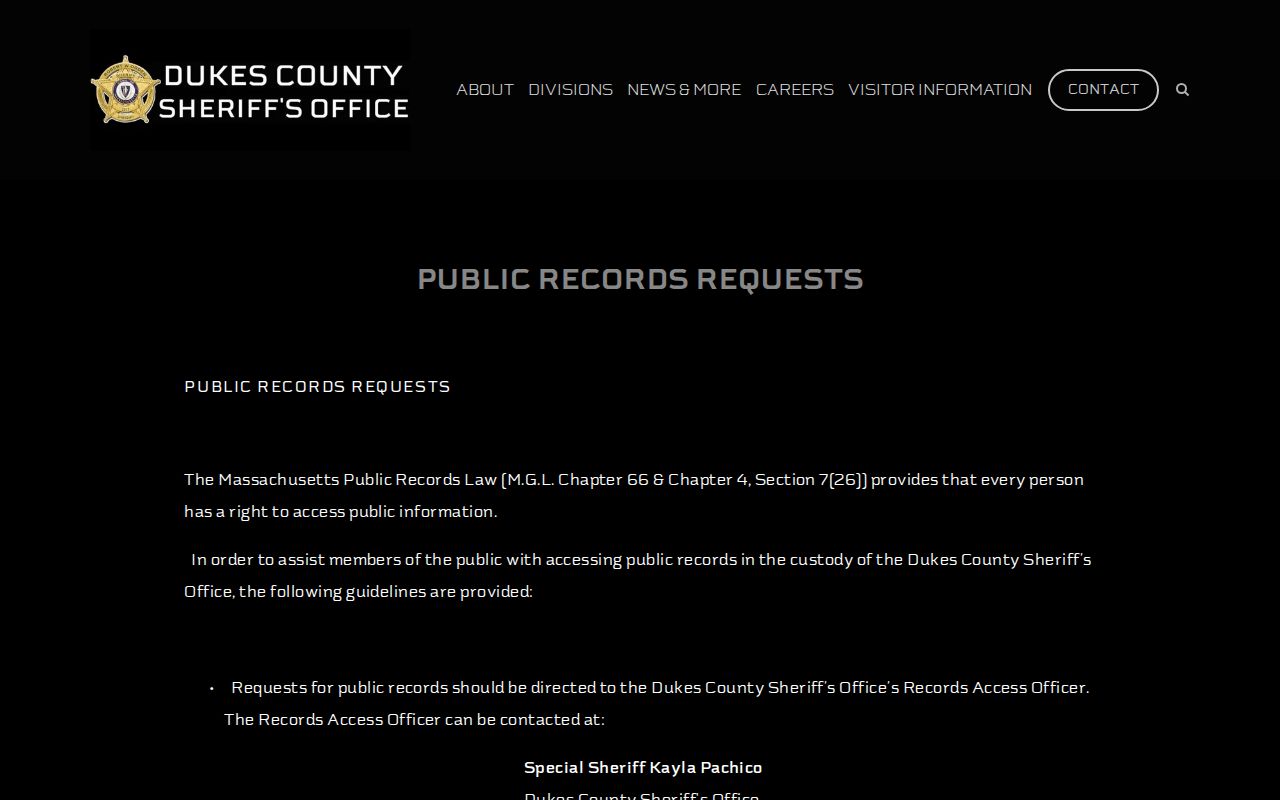
The official route supports a narrow request for the photo and related release record without relying on a public gallery.
- Name the person and add a date of birth or another safe identifier when known.
- Give the approximate booking or admission date and booking number if available.
- Ask for the standalone booking photograph from that specific event. If needed, list the booking sheet separately.
- Request electronic delivery and ask for an estimate before charges exceed an amount you choose.
- If access is denied or redacted, ask the office to identify the exemption or order it applied.
Writing is not required, but a written request reduces mix-ups and preserves the scope. DCSO posts no fixed mugshot fee or special photo form. Reasonable production fees may apply. Under M.G.L. c. 66, §10, the Records Access Officer generally responds as soon as practicable and within ten business days, but that response may provide records, quote time and fees, seek clarity, or cite a basis for withholding. It is not a promise of full production within ten days.
A useful scope is: “Please provide the standalone booking photograph for the named person, with identifying detail, from the booking on or about the stated date. Electronic delivery is preferred. Please quote any fee before processing.” Do not claim that every image must be disclosed. The office must conduct a record-specific review.
Dukes Mugshot Custodian Matters
The Edgartown facility holds men. Women in Dukes cases may be placed at Barnstable County Correctional Facility in Bourne. If Barnstable took the booking photograph, use the Barnstable Sheriff public-records route and identify the Dukes court, docket, person, and date. A Dukes court record does not transfer ownership of Barnstable’s institutional image to the Dukes sheriff.
If the person later entered state prison, MADOC may hold a separate institutional photograph. Submit that request through the MADOC records process. Its page expressly says the Department does not handle county jail or house-of-correction records. Requesting the Dukes booking image from MADOC merely because state custody came later will reach the wrong custodian.
The Massachusetts Sex Offender Registry Board has another narrow channel. Public SORB information can include a photograph when available for registrants whose classification is lawfully public. That system covers only people with a qualifying registration duty. It is not a general list of released Dukes County inmates, and absence from the public search proves neither release nor lack of a registration duty.
Dukes Mugshot CORI Review
Massachusetts draws a careful line. Under 803 CMR 2.03, a booking photograph standing alone is not Criminal Offender Record Information, commonly called CORI. Information on a booking sheet can be CORI. That distinction supports asking for the image by itself, but it does not make every photograph automatically public.
M.G.L. c. 4, §7(26) includes photographs within the public-record definition and also recognizes exemptions. Privacy, investigatory needs, facility security, juvenile confidentiality, a court order, sealing, expungement, and another statute may affect access. The leading Supreme Judicial Court booking-photo case cited by the state involved public officials and a strong public-accountability interest. That result should not be stretched into a rule for every ordinary booking.
The state’s official court-case summaries provide the context for that booking-photo decision.
Requesting one standalone image gives the custodian a precise record to review. If the agency relies on privacy or another exemption, ask for its written legal basis and any reasonably segregable part that can be released.
Dukes Mugshots Do Not Prove Release
A photograph proves that an image was associated with a booking or institutional record. It does not prove when custody ended, why it ended, whether charges were resolved, or whether another agency took custody. Pair the image with the sheriff’s release entry and the correct Trial Court docket.
MassCourts may show bail, recognizance, dismissal, plea, sentence, jail credit, probation, or later orders. Most remote criminal searches work best with the docket number. The sheriff’s timestamp remains the stronger source for when the physical release was processed. If the record names MADOC, another county, a warrant, federal authority, or immigration authority as the destination, the person left one facility but did not necessarily return to the community.
The full records and custody comparison appears on the Dukes County released inmate search. Use it to connect a photo with the actual release type rather than relying on a caption.
Identity checks matter too. Compare the booking date, court, charge context, booking number, and any lawful identifying fields before concluding that a photograph belongs to the person sought. Similar names are common. An old image copied into a later story can also make the event date look newer than it is. The originating record remains the place to confirm both identity and date.
Dukes Mugshot Sealing Effects
Sealing and expungement are separate Massachusetts processes. Sealing restricts ordinary public access to a qualifying criminal record. Expungement is narrower and removes qualifying records through the statutory process. Neither follows automatically from release, dismissal, or the passage of a few days.
The official Massachusetts sealing eligibility page explains that timing can be tied to the later of disposition or release.
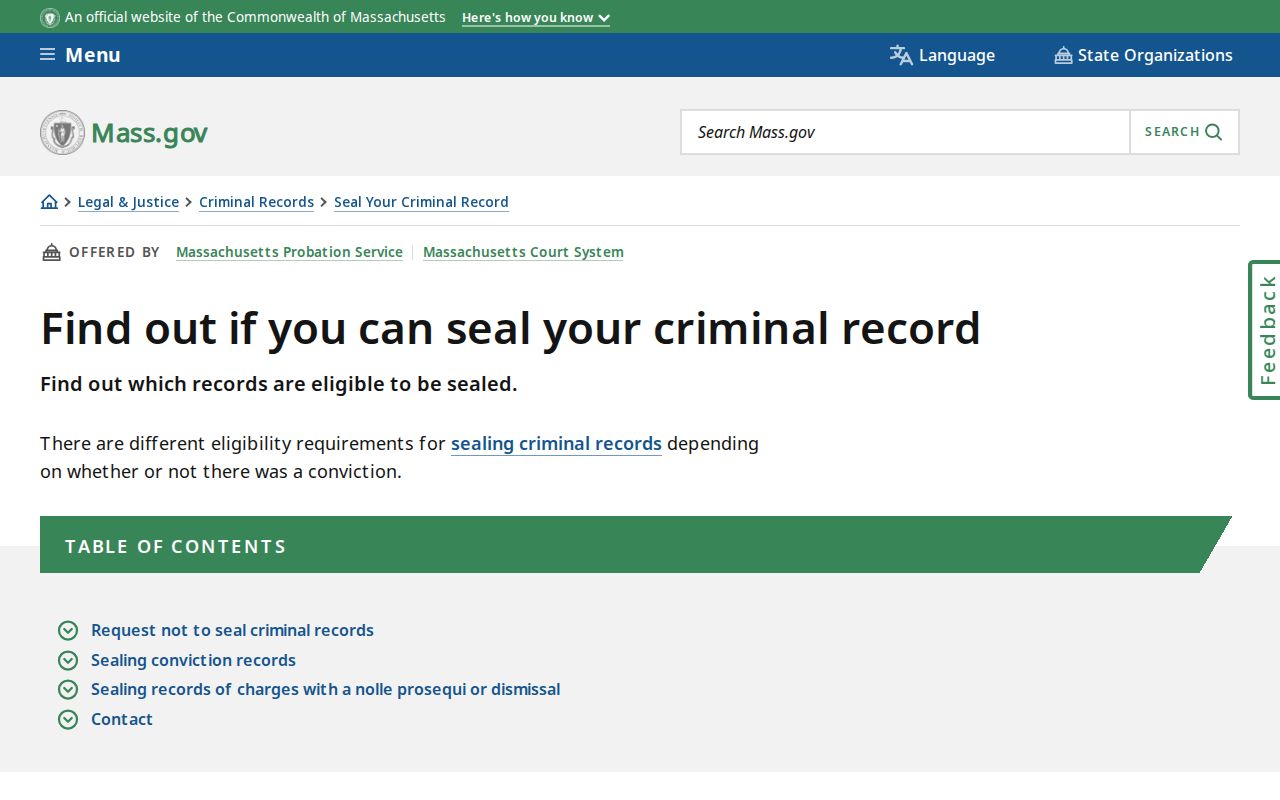
A sealed court case may vanish from ordinary docket access while an institutional photo remains subject to the custodian’s own law, order, exemption, and retention schedule. An expungement order can have broader effects, but no result should be promised for every copy once held elsewhere.
No enacted Massachusetts law was found that creates a broad mugshot-specific pay-to-remove right like statutes in some states. General privacy, sealing, expungement, publicity, and consumer-protection rules are not an automatic photo-removal tool. No commercial gallery or removal vendor is endorsed. For an official image, send the agency the applicable sealing or expungement order and ask how it affects that specific record.
Note: A removal request and a public-record request are different processes, even when they concern the same image.